Usually I am blogging about Berlin, but just for a change here are some photos of a quick tour we did of Spain. ¡Viva España!
Thursday, 16 April 2015
Valencia: City of Arts and Sciences
Valencia is very much a city of two halves: there are the gothic and baroque churches, the narrow alleys and town-walls of the old town. And then there is the stunning new architecture of the so-called 'City of Arts and Sciences' (Ciutat de les Arts i les Ciències in Valencian, and Ciudad de las Artes y las Ciencias in Spanish).
Both have their charms, but whilst the old town is so-much same-old, the modern quarter is totally unique to Valencia. Any of my photos of the churches could have been taken in any European town and you wouldn't be able to tell the difference, but the townscape of the City of Arts and Sciences is undoubtedly Valencia.
Wednesday, 15 April 2015
Alzira, Valencia
We stayed for a few days in Alzira, which has a history stretching back to its foundation by Muslim Moors. It remained a Moorish walled town until its conquest by James I of Aragon in 1242.
Parts of its town walls have been restored, but otherwise the most memorable aspect of the town is not visual, but the continual smell of sweet orange blossom wafting in on the breeze from the acres and acres of orange groves surrounding Alzira.
Tuesday, 14 April 2015
The Castle of Xàtiva, Valencia
Xàtiva (Spanish: Játiva) is a town near Valencia with a long and distinguished history. It's name is itself pre-Roman; in the Iberian language it was known as Saiti, which the Romans latinized into Saetabis. The Roman city was on the important Via Augusta, which stretched 1,500km from Cadiz at the tip of the Hispania province, running up the East coast of the Iberian peninsular to the Pyrenees, and connecting Cartegena, Xàtiva, Valencia, Sagunto, Tarragona, Barcelona, and Girona with the Via Domitia and eventually to Rome. Xàtiva was famous in Roman times for its flax production and the manufacture of linen fabrics, and is mentioned by the poet Gaius Valerius Catullus (84-54 BC).
After the Muslim conquest of 711, the city was calle مَدينَة شاطِبَة (madīnat Ŝāţibat, usually transcribed as Medina Xáteba). The Arabs brought paper manufacturing technology to Xàtiva, and the city became a pioneer of paper manufacture and thence writing and learning in Europe.
Xàtiva was conquered and re-Christianised by James I of Aragon in 1240, but the mosque and Arabic population were respected until the sixteenth century.
Xàtiva is the birthplace of two popes, Callixtus III and Alexander VI, and also the painter José Ribera (Lo Spagnoletto).
Sunday, 12 April 2015
Parc de Montjuïc, Barcelona
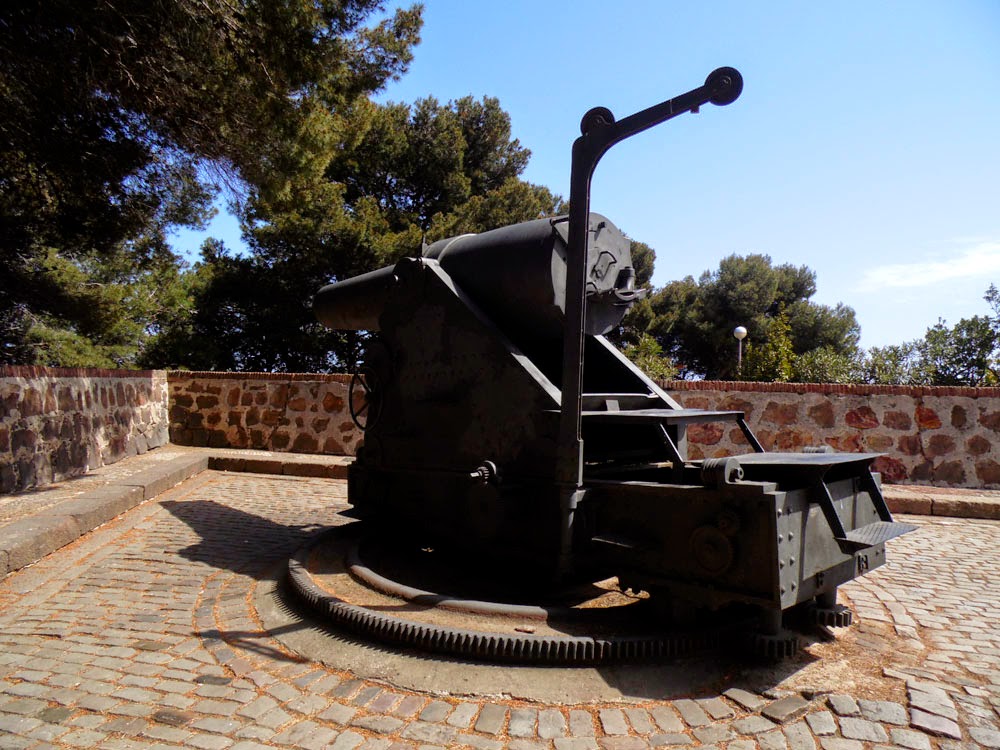
After a wander along La Rambla again, we took the cable car up to Fort Montjuïc and wandered down through the park to the Olympic Stadium.
The incredible views from up there made us appreciate how big Barelona, and its container port, really are.
Subscribe to:
Posts (Atom)